Okay, I'm totally going to blow this entry off. I have a cold and I am tired and am not feeling very inspired to write. We went to the Ming Tombs today (the specific site was called Dingling). I found the tomb itself a bit sparse, but enjoyed the grounds. Here is some info courtesy of Wikipedia followed by some pictures I took.
-----
The Ming Dynasty Tombs (Chinese: 明朝十三陵; pinyin: Míng cháo shí sān líng; lit. Thirteen Tombs of the Ming Dynasty) are located some 50 kilometers due north of urban Beijing at a specially selected site. The site was chosen by the third Ming Dynasty emperor Yongle (1402–1424), who moved the capital of China from Nanjing to the present location of Beijing. He is credited with envisioning the layout of the ancient city of Beijing as well as a number of landmarks and monuments located therein. After the construction of the Imperial Palace (the Forbidden City) in 1420, the Yongle Emperor selected his burial site and created his own mausoleum. The Ming tombs of the 13 emperors of the Ming Dynasty were located on the southern slope of Tianshou Mountain (originally Mount Huangtu).
The site of the Ming Dynasty Imperial Tombs was carefully chosen according to Feng Shui (geomancy) principles. According to these, bad spirits and evil winds descending from the North must be deflected; therefore, an arc-shaped area at the foot of the Jundu Mountains north of Beijing was selected. This 40 square kilometer area — enclosed by the mountains in a pristine, quiet valley full of dark earth, tranquil water and other necessities as per Feng Shui — would become the necropolis of the Ming Dynasty.
Dingling (Chinese: 定陵; pinyin: Dìng Lìng; literally "Tomb of Stability"), one of the tombs at the Ming Dynasty Tombs site, is the tomb of the Wanli Emperor. It is the only one of the Ming Dynasty Tombs to have been excavated. It also remains the only imperial tomb to have been excavated since the founding of the People's Republic of China.
-----
In the plaza at the entrance of the site, looking out toward the hills.
Entrance gate at Dingling
Walkway descending into a tunnel
Trees grow on top of the tomb itself
After descending down several flights of stairs you find yourself in the tomb which is littered with money. Evidently, there was a hole underneath this pile of cash and it is considered lucky if you can toss your money in there.
Original archway
The emperor's throne. If I were the emperor I would have had them at least put a few pillows on that baby.
The large red boxes are the imperial coffins while the small ones are said to hold their belongings
The Chinese apparently like to pay taxes to all leaders, dead or alive.
M.C. Escher doorway
On the way out of the tomb I happened upon this beautiful dragon light fixture decoration.
This place was beautiful, covered with trees as far as you could see. Unfortunately, the smog was kind of ruining the view of the hills.
I enjoy interesting uses of hyphenation... or the lack thereof.
There were a couple of galleries of artifacts around the site. This is a lavish headdress that would have been worn by one of the royal family.
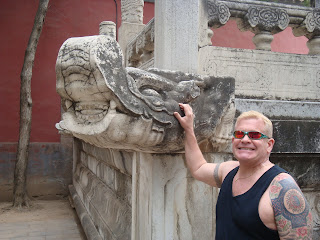
Tony poses with a stone carving that he likes.
This big ass turtle stood a foot taller than me and had a huge tablet with Chinese writing on it protruding from its shell several feet into the air.
More from Wikipedia:
-----
A seven kilometer road named the "Spirit Way" (Shen dao) leads into the complex, lined with statues of guardian animals and officials, with a front gate consisting of a three-arches, painted red, and called the "Great Red Gate". The Spirit Way, or Sacred Way, starts with a huge stone memorial archway lying at the front of the area. Constructed in 1540, during the Ming Dynasty, this archway is one of the biggest stone archways in China today.
-----
When we got here, we sat down for a nice bread and cheese picnic before proceeding down the pathway between the impressive statues.
Lovely soft willows lined the way
Here are a few shots of my favorite statues:
Througout the site there were these great little tables with elephants as chairs.
The dragon and phoenix gate at the end of Spirit Way.
Last night, the parents, Marie, and I bundled in to a cab and took a short ride over to the relatively new second location of the Da Dong Roast Duck Restaurant, right on the 3rd Ring Road in the Chaoyang district. Pop had been raving about this place since before we had arrived in Beijing. Da in Chinese means “fat,” while Dong is the eponymous founder of the restaurant. Among Beijinger’s and ex-pats alike, it is heralded as the best Peking duck in town. The wall of awards from every major newspaper in China, the Zagat guide, and Chinese and world culinary foundations declaring it the winner in every category imaginable is the first thing you see upon entry in to the two story building. So our expectations and excitement were pretty high.
After a brief wait (there were 15 tables ahead of us- and we only waited about 10 minutes) we were led in through the main first floor dining area to our table. If the first floor is any indication of the second, the restaurant is easily a 1000-seat facility. Wait staff, floor managers, duck carvers in high toques, and bussers were all doing the frenetic dance around tables, customers, and stacks of dishes that is so clearly a part of renao- the Chinese term for the crowded, boisterous, and steaming hot atmosphere of the restaurant dining room.
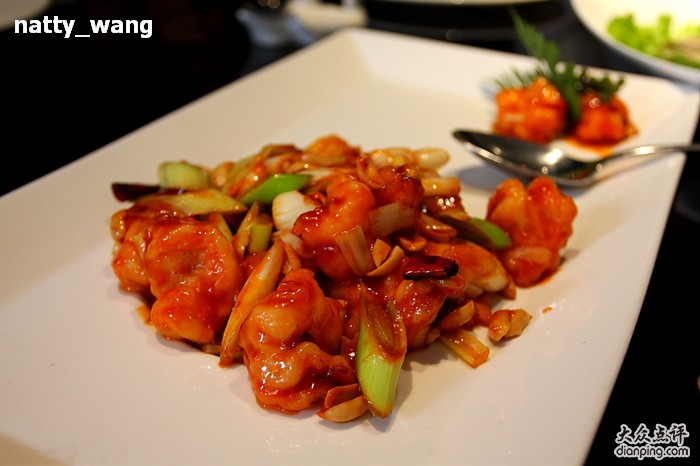
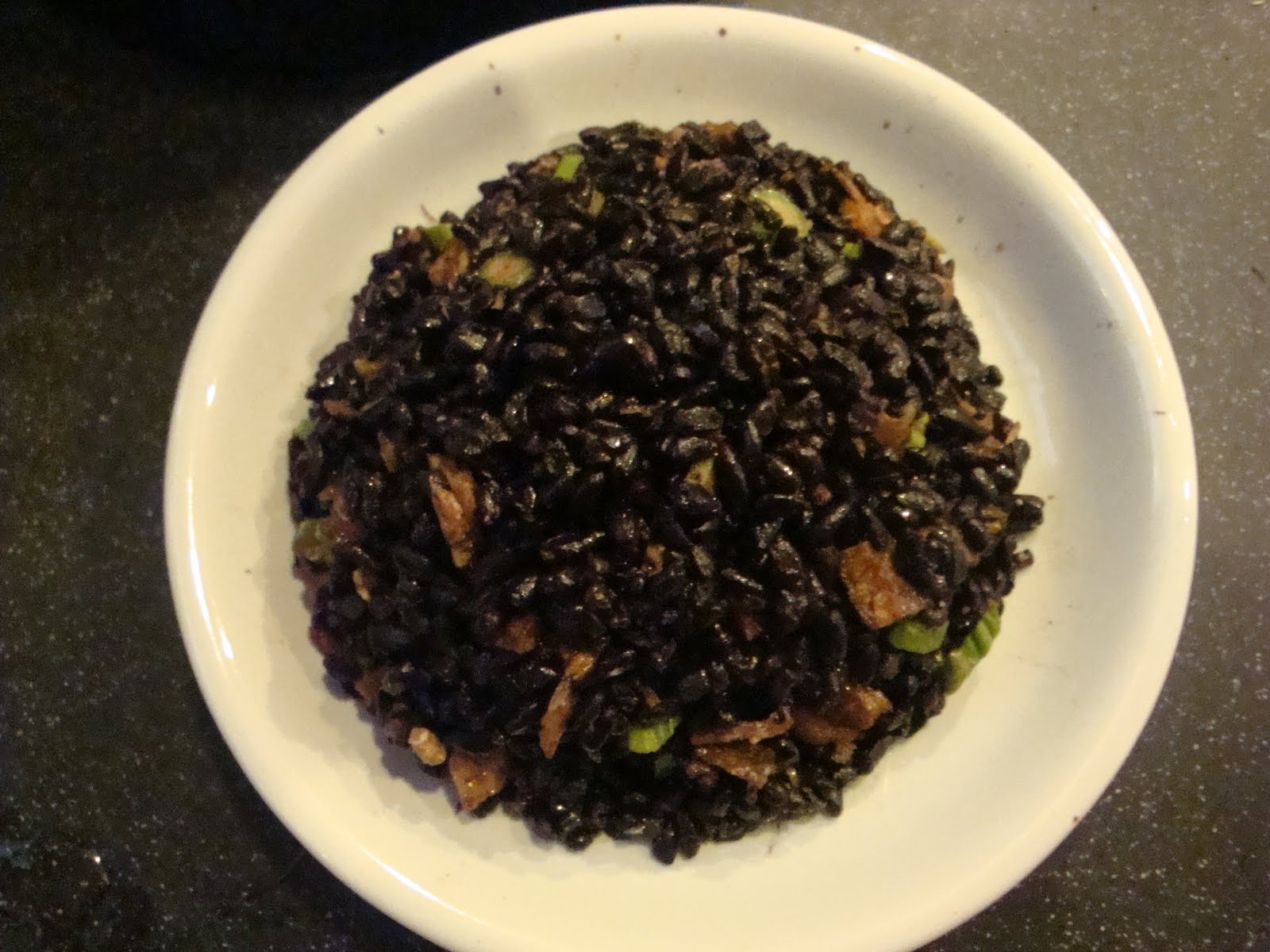
We ordered brined duck liver, Sichuan style sweet and sour shrimp, lotus leaves and ginkgo nuts, Chinese purple rice, an eggplant dish, chili tofu custard, and finally the roast duck.
After our drinks of beer (Mom), an excellent locally brewed non-alcoholic beer and the requisite chrysanthemum tea were served, our food began to arrive. First, the brined duck liver. I’m not sure exactly how it is prepared, but the taste and texture of the foie seem to be the product of a well-fed duck, but clearly one that has not undergone gavage, as in foie gras. The long brining removes most of the sulfur from the liver making for an extremely delicate and light organ flavor, and reduced fat content makes for a more brittle, light mouth-feel. After the liver has been brined, it then is most likely steamed over a broth containing star anise, which imparts the slightest hint of bitter licorice to the meat. In all, it is the best liver I’ve had.
As the wonderful delicacy of the foie melted away, the shrimp came. Fresh shrimp, tossed in corn starch and shallow fried to crisp perfection, in an orange, vinegar, Sichuan pepper, peanut and chili sauce. The shrimp were beautifully sliced so their backs opened like a floral display, and the interior meat was done just right- toothy and brackish and sweet. An interesting side attraction to the dish was the decorative garnish of a small fruit-bearing twig of the Sichuan pepper tree. It looked exactly like a tiny caper branch, but when I bit in to the small berry a combination of eucalyptus and juniper jumped out. None of the numbing power of the aged peppercorns was felt- it seems those volatile oils develop later.
Next to arrive was the purple rice. This wonderful dish is made with wild short grain rice steamed with black tea and then tossed with minced and stir-fried scallions, green garlic shoots, and run chang, a traditional Chinese sausage made with pork meat and duck liver. The result is a demure dish that again is toothy and a duff-like taste, but interspersed with the sharp saltiness of sausage. It was wonderful.
Following the mellowness of the rice came a surprising exhibition of sharp, bold flavor muted by the tenderness of slowly braised vegetable fiber. Eggplant carpaccio arrived, piled high and tossed with a smoky sweet spicy sauce. The sauce was oily, but the expert work in the kitchen did not end up with small spongy ring of oil. Instead, the thin slices melted away as we chewed them whole. From the size of the rings, it was composed of European rather than Chinese eggplant, with the skins still on.
I don’t think that lotus leaves are available in the U.S., but dagnamit, they should be. The lotus figures prominently in Buddhist imagery and symbol, representing in myriad ways the transcendence of the vulgar to the sublime. Likewise, the translucent pale leaves, looking much like trimmed artichoke petals, are slippery yet crisp, subtle yet definite, unique but somehow familiar. They are a rare treat. I had never had them prepared in a dish with gingko nut, but the pairing is exquisite. Gingko, prior to ripening and becoming the malodorous hell-in-a-nut, is rich, sweet, nutty, and has a- for lack of better descriptors- muddy/boggy taste. This may not sound as appealing as it actually is, but like everything else in the meal, it was delicious. The simplicity of the dish really shows how you can take two ingredients, and using nothing but a little oil, some water, and heat to bring out dozens of intricate flavors. This, on top of the appeal to the Buddhist imagery, makes the dish a meditation in itself.
The next dish to arrive was my favorite of the meal. Individual tofu custards arrived each in a soup spoon ringed by steamed broccoli florets flavored with a little soy sauce. The Chinese have an affinity for silken tofu, an extremely soft soy bean curd, just on the verge of being viscous. I detest the stuff. It feels like a mouthful of loogie, usually served in a fairly flavorless broth. So I was incredibly surprised to enjoy these little spoonfuls as much as I did. The chefs had taken a soy bean product, somewhere between the stage of soy milk and silken tofu, fortified it with a few egg yolks (and probably another powdered stabilizer), then steamed it into an inch and a half high custard, about an inch in diameter, with a deep well in the middle. This was filled with shredded dried baby shrimp, bonito, and chili oil. The idea was to put a floret in your mouth and drain the spoon, custard and all, then mix it in your mouth. The gooeyness (still quite loogie like, but a little firmer) was lessened by the fiber in the broccoli, and then the sharp and chewy shreds (the texture of shredded beef jerky) made little “surprises” for your moth. The flavor was fishy and spicy, the bitter sulfur of the broccoli muting the sweetness of the tofu and egg. What was so fun about this dish is that it was a beautiful demonstration of kou gan, literally translated from Mandarin to be “mouthfeel.” An easy example of this major element of is the frequency with which you see bone shards left in meat after butchery in China. These are not seen as evidence of inexpert flaws in skill, but are rather a highly desired effect, done solely so that your mouth will have something else to do than just taste. Where mouthfeel to Europeans means the degree to which a sauce or liquid coats the mouth and tongue, or the weight of a dish has on your perception of the dish as a whole, to Chinese it means something which incorporates all the more senses in to the meal.
Finally, the main event- Beijing roast duck. Traditional duck raised and heavily fatted just prior to being killed, plucked and the innards removed. It is then hung to dry for several hours. A glaze of honey, vinegar, sherry, cornstarch, ginger and scallion is brought to a boil then spooned over the duck, which is then dried again so the glaze adheres well. It is then roasted in such a way that the majority of the fat renders leaving a skin crispier than a potato chip, the meat tender and flavorful. The bird is carved into stock card thickness chunks, which are dipped in plum sauce, garnished with julienned spring onion and cucumber and wrapped in bing, a paper-thin flour pancake. It is delicious, but very greasy and huge chunks of fat still cling between the skin and meat. The founder of this restaurant however, after studying in the west, developed a new way of raising the ducks so that the meat becomes marbled with fat rather than requiring the overfeeding to develop a layer of subcutaneous fat that serves as the transport of the delicious duck flavor. In addition to the three traditional garnishes above, this restaurant provides Chinese red radish, grated garlic, salt, and two pickled relishes.
The meal ended with ba si, a delicious Chinese dessert a throwback to my childhood. The chef will take several apple wedges, roll them in cornstarch, dip them in boiling lightly caramelized sugar and bring them to the table. The cornstarch provides a base layer for the sugar to adhere to, which in turn cooks the apple through, and in the minute or so it takes to run the plate to the table, the sugar begins to cool just enough that when you pull four dumpling, long strands of sugar trail behind. You quickly dip the wedges in to ice water which instantly seizes the sugar into a hard candy shell, leaving the enclosed apple boiling hot and just on the hard side of gooey.
Today Charlie, Tony, Elena and I rented a car and drove out to Mutianyu to see the Great Wall. On our way there and back I got a nice glimpse of life in rural China as we passed through a couple of small towns en route to the Wall. This was more of what I always thought China would look like. There were green trees everywhere and it was dry and hilly, a lot like some areas of Idaho. I saw a small herd of bony cows and a shepherd with his flock. We passed several shallow streams alongside which people fished or picnicked. The little towns, being so near such an important monument, bustled with traffic and street vendors in open air markets. Our driver took us down some not-so-major streets and I was able to peer down the quiet alleys and into the slightly cracked plain metal doors embellished minimally with what certainly must have been luck-bringing flair. I watched a little stooped-over old man shuffle down the street to take refuge from the sun in a small garage along with a couple of his peers where they sat calmly around a table enjoying tea and watching traffic go by.
Photographically, it is really difficult to capture what this place is actually like. I can shoot interesting buildings, people or activities, but it never really does it justice. The photos all come out looking dull and random and unfocused as far as subject matter is concerned. Even video may not do it justice. You really just have to be here to experience it. You have to take in all the little fleeting details for which you would never think to whip out a camera. You have to smell the dusty, polluted air mixed with the smells of cooking street food, fresh produce, raw meat, and blooming flowers. You have to hear all the sounds at once, a cacophony of traffic horns, squeaking brakes and revving engines mixed with birds, the sing-song cries of the street vendors and pleasant chatter in a variety of dialects and accents.
You have to see the people. Old folks dressed in drab blue or gray traditional Chinese button-up shirts and short-billed hats shuffle around, pausing to stare at us or at whatever is interesting, always curious, sometimes expressing disdain for whatever is going on. They are exactly what most Americans probably think a communist looks like. The younger and middle-aged crowd, wearing the latest ridiculous fashion, using the latest electronics, buzz around in nice cars or on trendy scooters. Families with one little bare-bottomed toddler each hold their little prize up in front of scenic attractions to take his or her picture for their photo albums. Hard-working laborers with leathery faces toil on bicycles under heavy loads of recyclables or building materials, disregarding motorized traffic altogether, intently focused on their own strife and how much more they might have to endure before reaching their destination. Loud, friendly women emerge from their shops to greet each other or sling their goods to the next passerby, both in Mandarin and sales English phrases such as, "Good price!" or "Have a look!" They always have something that is good for something else, guaranteed to bring good luck, wealth, great skin or weight loss.
For me, China is all of these things. You cannot capture such complexity with a camera. This is something that must be taken in with all of the senses. I only wish I had more time here to discover and understand the subtleties of such a large country with so many kinds of people, languages, and cultural nuances.
All that being said, I will now recount and show you some lovely pictures of our outing today. Just keep in mind that what you see here is only the tip of the iceberg. If you like, I encourage you to get your ass on a plane and come experience it for yourself.
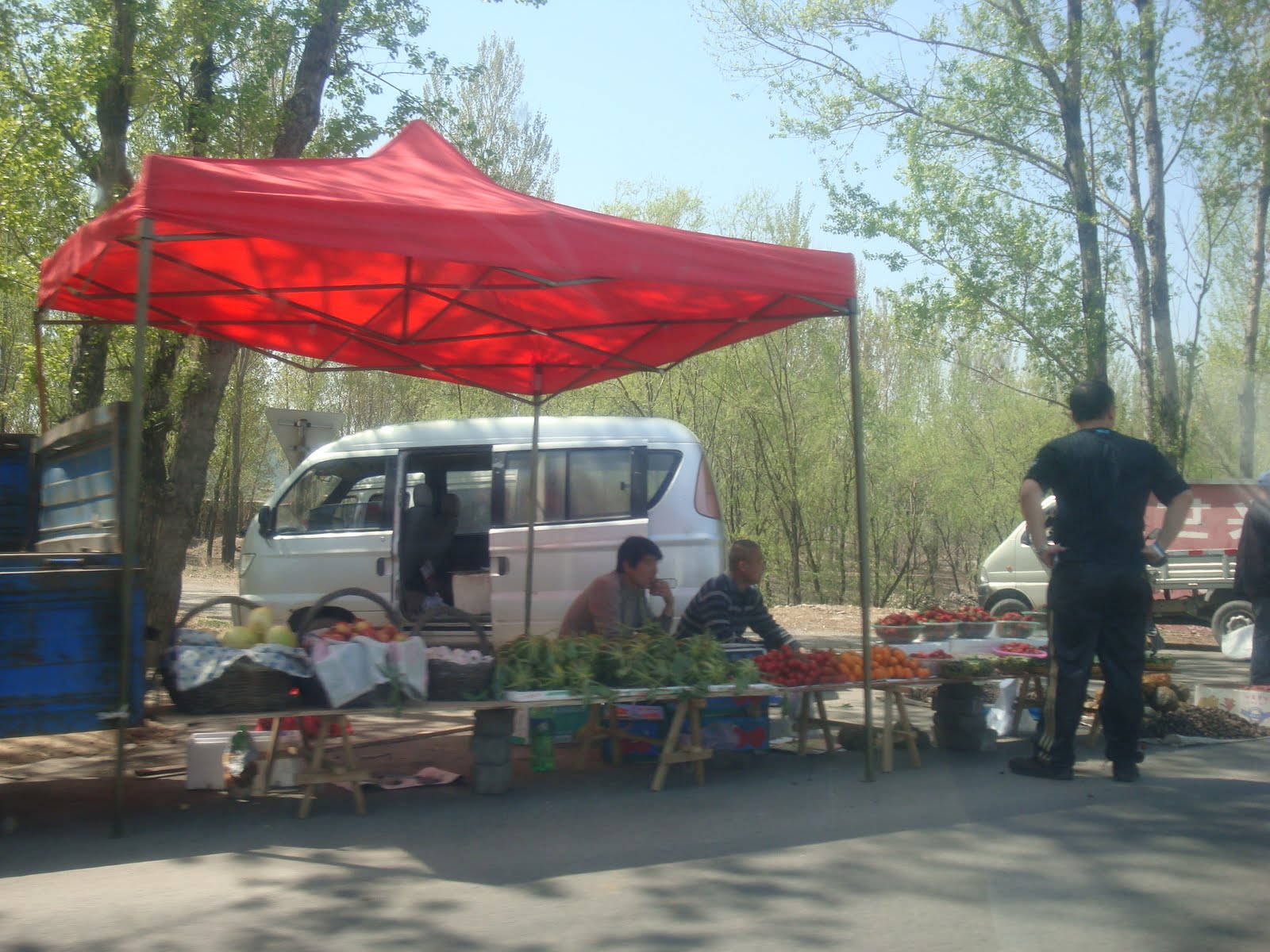
So where was I? Oh yes... on our way to Mutianyu we passed through some towns. Here are some very vague images of what rural China kind of looks like.
After about a 2-hour drive out of Beijing, we finally arrived in Mutianyu. We made a pit stop at a horrible public toilet (although I have seen worse) where it was so crowded and there was so much competition that you literally had to stand right in front of the stall door to wait for the occupant to come out so that you could push passed her into the stall before someone else did. I even saw one eager woman push her way into the stall before the user had exited. While I observed this chaos and eventually pushed my way in for a turn, Tony was off pushing his way through a crowd to get a tickets for the cable care that would take us up to the Great Wall. I was relieved to learn that this was our method for getting there after seeing the hillside towering over us and trying to prepare mentally for the physical torture that I knew climbing it would be.
Making our way up the crowded pathway toward the cable cars, we were hit up by several vendors hawking their touristy wares. Feeling the heat on my face already, I knew I was going to need a hat so I opted for one of the green communist hats with the red star sewn on the front. I thought they were cool and figured I wouldn't look like too much of an ass wearing it since I had seen several other Chinese people with it on, unlike the time in Hong Kong when I purchased a woven conical hat and embarrassed the hell out of Charlie with it. Charlie approved enough of my new hat that he bought one for himself too.
Nearing the cable car, Charlie asked, "Did you see the camel?" I had seen a camel out of the corner of my eye, but as it was sitting dead still I figured it was a fake photo-op prop and ignored it. Realizing that it was a live camel, I gasped like an excitable 5 year-old and immediately made my way over to it, happy to pay any price to sit on it and have my picture taken.
Yay!
My fuzzy buddy: well-mannered and extremely smelly. This was the first time in my life that I had ever had the pleasure of being so close to a camel and it was delightful.
After that, we continued up the hill and got into our cable car. Here is a video of our ascent to the wall. Conveniently, Tony was making his own video at the time so he can be heard narrating it. Yes, that scary, rickety knocking sound is the cable car.
As the earth dropped out beneath us we began to be able to see the small populated valley from whence we had come, and above us along the hilly ridge the snaking fortification slowly came into view.
We alighted atop the hill onto a wide plaza and were greeted by the first of many sets of knee-high irregular steps which require a little extra balance and muscle strength to scale. Elena, Charlie and I went up first so that Tony could get this matching hat picture that I forced Charlie to endure.
Looking uphill in the distance you could see a few Chinese characters on the hillside calling its readers to "Respect Chairman Mao".
In an attempt to avoid too much bodily hardship, we took the most downhill route we could along the wall, only having to suffer through a couple of short stints of stair climbing. Even though it was downhill it was still difficult. All of the stairs are irregular, some only a couple inches in height, while others are almost two feet high in areas. One must pay close attention so as not to trip and face plant on the hard stone walkway, a real risk at any given time. Plus, after going down so many stairs with such care our legs were just as wobbly as if we had been walking uphill the entire time.
Stairway from hell.
Just to the right of the farthest hill where you can still see the wall in this picture, there are two little red dots just to the right. This is our destination.
As you can see, the wall is not very wide, but is pretty high.
No Climb-Over. No shit.
If you stick your head into the openings on the sides you get a nice natural blast of air conditioning, which was very welcome on this hot day. I took comfort in knowing I was not the only red-faced panting tourist attempting to schlep my way along the all in the hot sun. The interior of the guard towers provided shelter from the heat and many people would sit inside them to rest.
There were vendors parked in the few shady corners along the way, offering ice-cold water, soft drinks, beer and popsicles. Unfortunately, the site suffered because of this.
Here are a couple more shots and video panoramas to give you a better idea of what the area looks like.
Also, before our journey ended, I insisted that Charlie misbehave acrobatically on yet another important Chinese monument.
Our method of getting back down the hill was exciting and unconventional. Much to my surprise and delight the Great Wall has a toboggan ride!
I followed the rules like the guy loading people onto it instructed and did not use my camera during the ride. Anyway, I was a little unsure about my abilities to operate a toboggan with only one hand. Here's a picture of the ride beforehand.
And lucky for all of you, some other hilarious tourist did break the rules and videotaped his ride down the hill. It really is as fun as it looks. I could have done it all day long.
And thus our sightseeing at the Great Wall concluded. We traipsed back down the hill to meet our driver. Along the way I saw a woman with one of those fruity popsicles, the kind that is actually mashed up frozen fruit, and I decided I had to have one. With my strawberry popsicle in hand like a child who had just won a prize, I happily loaded my exhausted butt back into the car for the long journey back to Beijing.
We stopped on our way back to buy some cigars and see the school that Charlie had attended during his stint in Beijing from 1989-1993 and then headed back to the apartment where I blogged and Charlie and Tony enjoyed cigars on the balcony while Tony played the harp.
Just look at him. That's even a Cuban cigar. Damn commie.
After a short rest, we ventured out to Da Dong Roast Duck, Beijing's most famous Peking duck restaurant. Like a complete idiot, I forgot my camera, which is rather unfortunate because the presentation was really nice. Please see the next blog entry for Charlie's write up of the meal. Hopefully by the time it posts I will have found some pictures of this restaurant's food online that I can include. Bon Appetit!